> ## Documentation Index
> Fetch the complete documentation index at: https://docs.a2v2.ai/llms.txt
> Use this file to discover all available pages before exploring further.
# Agent Analytics (Beta)
> See how a single agent is performing — conversations, messages, visitors, answer quality, and paid-access revenue — so you know what to improve next.
You've embedded an agent and people are using it. Now what? **Analytics** turns that
activity into a picture you can act on: how many people are chatting, how deep the
conversations go, where the agent can't confidently answer, and — if you charge for
access — how much it's earning. Its subtitle sums up the intent: *"See how your
agent is performing — and where to improve it."*
Open it inside an agent's workspace at **Agent → Analytics**. Analytics is **per
agent** — each agent has its own report. (For credit *spend* across all agents, use
the org-wide [Usage dashboard](/analytics/usage) instead.)
**Analytics is in Beta.** The reports are live and useful today, but they're still
expanding. Some tabs may show a "coming soon" state — *"We're building this out
next. Overview is live today."* — while they roll out.
 ## The date range, everywhere
Every report responds to the date range picker at the top. You can pick a preset —
**Last 7 days**, **Last 30 days**, **Last 90 days**, **Month to date** — or a
**Custom range**, and optionally **Compare to previous period** to see whether a
number is trending up or down.
## Overview — engagement at a glance
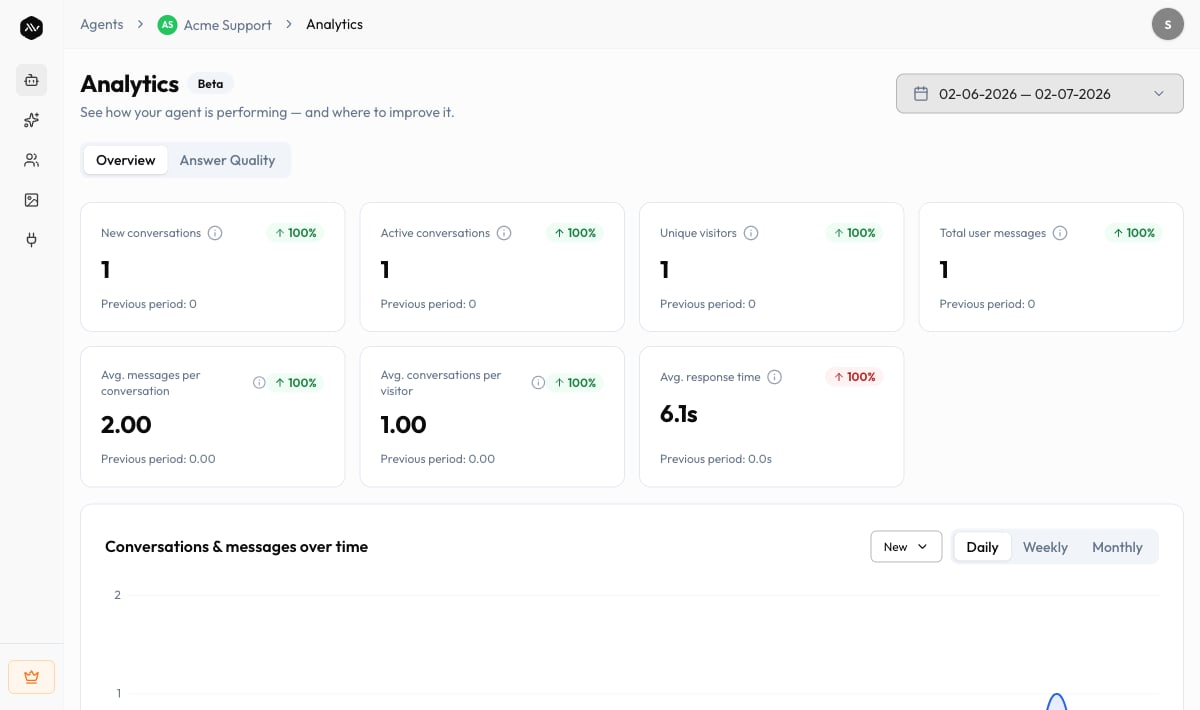
The **Overview** tab is the live heart of Analytics. It answers "are people using
this, and how much?" with a row of key figures and trend charts.
### Key figures
| Metric | What it tells you |
| ---------------------------------- | --------------------------------------------------------------------------------------------------------------------------------------- |
| **New conversations** | Chats that started during the selected period. |
| **Active conversations** | Chats with any activity — a visitor or bot message — in the period, even if they started earlier. |
| **Unique visitors** | How many different visitors chatted. Anonymous web visitors are counted per device/browser, so one person on two devices counts as two. |
| **Total user messages** | Total messages sent by visitors in the period. |
| **Avg. messages per conversation** | How deep conversations go on average — higher usually means deeper engagement. |
| **Avg. conversations per visitor** | How often visitors come back — higher means returning users. |
| **Avg. response time** | Average time the agent took to start replying, in seconds. Lower is better. |
When **Compare to previous period** is on, each figure also shows how it moved
against the prior window.
### Trend charts
* **Conversations & messages over time** — new vs. active conversations, and message
volume, plotted across the range. Switch the granularity between **Daily**,
**Weekly**, and **Monthly** to zoom in or out.
* **Busiest hours** — when your visitors actually show up, so you know when the agent
carries the most load.
A high **Avg. messages per conversation** with a low **Avg. response time** is the
sweet spot: people are engaging deeply and the agent keeps up. A rising
conversation count with flat unique visitors means the same people are coming back —
a strong signal the agent is genuinely useful.
## Answer Quality — find what your agent can't answer
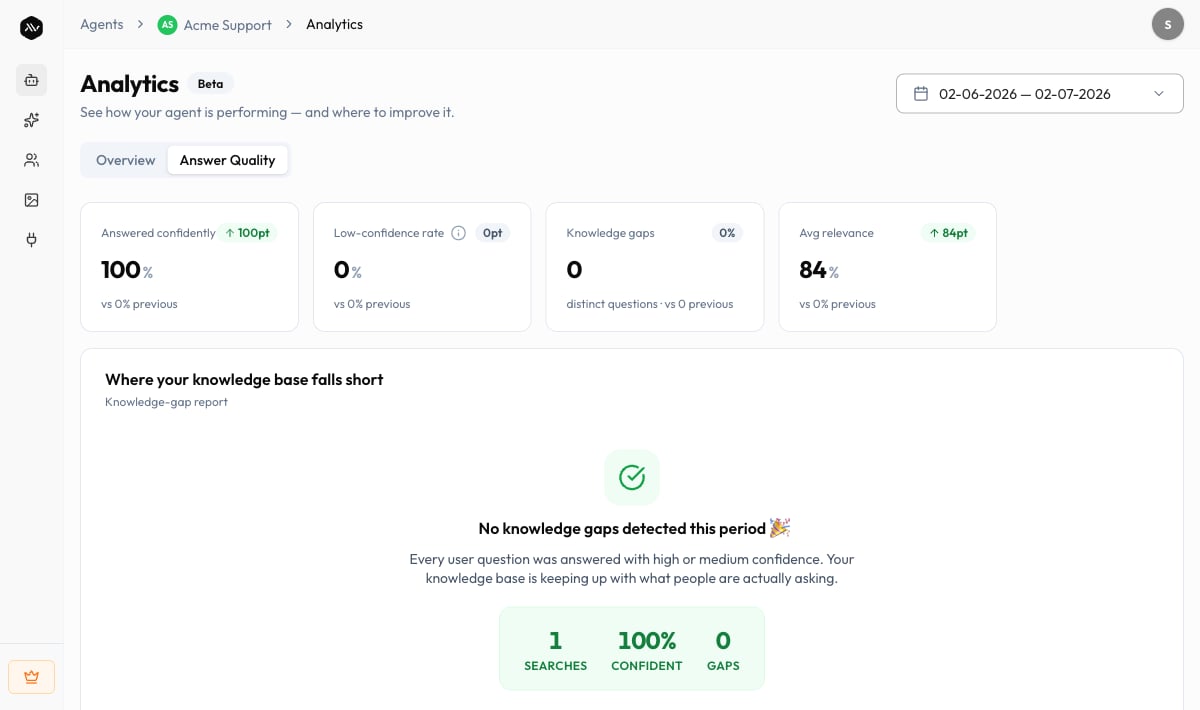
The **Answer Quality** tab is where Analytics earns its keep for a knowledge-base
agent. Instead of just counting chats, it scores how confidently the agent answered
and surfaces the **knowledge gaps** — the real questions visitors asked that your
knowledge base couldn't confidently cover.
What you'll find here:
* **Knowledge-gap report** — *"Where your knowledge base falls short."* A ranked list
of questions, how many times each was asked, their average relevance, and when they
were last asked. Each row has an **Add to KB** action so you can write the missing
answer on the spot — it goes live on the next search.
* **Confidence distribution** — how your knowledge-base searches split across **High
confidence**, **Medium confidence**, **Low confidence**, and **No match**, based on
retrieval relevance scoring.
* **Most-used** and **Underused documents** — which sources are earning their place
(cited most) and which were never cited this period and might be pruned.
Answer Quality depends on **adaptive retrieval** being enabled for the agent. If it's
off, this tab prompts you to turn it on before it can score searches and surface
gaps. Tracking is **forward-only** — gaps and document usage are measured from the
point adaptive retrieval was switched on, not retroactively.
Treat the knowledge-gap report as a to-do list for your knowledge base. Every gap is
a question a real visitor asked and didn't get a confident answer to — closing it
with **Add to KB** directly improves future answers. See
[Add knowledge sources](/knowledge-base/overview) for more ways to fill gaps.
## Subscriptions — revenue from paid agents
If your agent uses **Pay for Access**, the **Subscriptions** view tracks what it's
earning: *"Track revenue, subscribers, and transactions from paid access."* You can
also reach it from the agent's **View Subscriptions** action.
| Metric | What it shows |
| ------------------------------------------ | ---------------------------------------------- |
| **Total Subscription Amount** | Total revenue earned from paid access. |
| **Total Subscribers** | How many people have purchased access. |
| **Total Hours Used** / **Remaining Hours** | Usage across all your subscribers. |
| **Revenue Over Time** | A revenue trend chart for the selected period. |
The transactions table lists each subscriber with the **Amount** they paid, their
**Subscribed On** date, **Used Time** / **Remaining Time**, and **Status**, with
**Filter** and **Sort** controls.
## The date range, everywhere
Every report responds to the date range picker at the top. You can pick a preset —
**Last 7 days**, **Last 30 days**, **Last 90 days**, **Month to date** — or a
**Custom range**, and optionally **Compare to previous period** to see whether a
number is trending up or down.
## Overview — engagement at a glance
The **Overview** tab is the live heart of Analytics. It answers "are people using
this, and how much?" with a row of key figures and trend charts.
### Key figures
| Metric | What it tells you |
| ---------------------------------- | --------------------------------------------------------------------------------------------------------------------------------------- |
| **New conversations** | Chats that started during the selected period. |
| **Active conversations** | Chats with any activity — a visitor or bot message — in the period, even if they started earlier. |
| **Unique visitors** | How many different visitors chatted. Anonymous web visitors are counted per device/browser, so one person on two devices counts as two. |
| **Total user messages** | Total messages sent by visitors in the period. |
| **Avg. messages per conversation** | How deep conversations go on average — higher usually means deeper engagement. |
| **Avg. conversations per visitor** | How often visitors come back — higher means returning users. |
| **Avg. response time** | Average time the agent took to start replying, in seconds. Lower is better. |
When **Compare to previous period** is on, each figure also shows how it moved
against the prior window.
### Trend charts
* **Conversations & messages over time** — new vs. active conversations, and message
volume, plotted across the range. Switch the granularity between **Daily**,
**Weekly**, and **Monthly** to zoom in or out.
* **Busiest hours** — when your visitors actually show up, so you know when the agent
carries the most load.
A high **Avg. messages per conversation** with a low **Avg. response time** is the
sweet spot: people are engaging deeply and the agent keeps up. A rising
conversation count with flat unique visitors means the same people are coming back —
a strong signal the agent is genuinely useful.
## Answer Quality — find what your agent can't answer
The **Answer Quality** tab is where Analytics earns its keep for a knowledge-base
agent. Instead of just counting chats, it scores how confidently the agent answered
and surfaces the **knowledge gaps** — the real questions visitors asked that your
knowledge base couldn't confidently cover.
What you'll find here:
* **Knowledge-gap report** — *"Where your knowledge base falls short."* A ranked list
of questions, how many times each was asked, their average relevance, and when they
were last asked. Each row has an **Add to KB** action so you can write the missing
answer on the spot — it goes live on the next search.
* **Confidence distribution** — how your knowledge-base searches split across **High
confidence**, **Medium confidence**, **Low confidence**, and **No match**, based on
retrieval relevance scoring.
* **Most-used** and **Underused documents** — which sources are earning their place
(cited most) and which were never cited this period and might be pruned.
Answer Quality depends on **adaptive retrieval** being enabled for the agent. If it's
off, this tab prompts you to turn it on before it can score searches and surface
gaps. Tracking is **forward-only** — gaps and document usage are measured from the
point adaptive retrieval was switched on, not retroactively.
Treat the knowledge-gap report as a to-do list for your knowledge base. Every gap is
a question a real visitor asked and didn't get a confident answer to — closing it
with **Add to KB** directly improves future answers. See
[Add knowledge sources](/knowledge-base/overview) for more ways to fill gaps.
## Subscriptions — revenue from paid agents
If your agent uses **Pay for Access**, the **Subscriptions** view tracks what it's
earning: *"Track revenue, subscribers, and transactions from paid access."* You can
also reach it from the agent's **View Subscriptions** action.
| Metric | What it shows |
| ------------------------------------------ | ---------------------------------------------- |
| **Total Subscription Amount** | Total revenue earned from paid access. |
| **Total Subscribers** | How many people have purchased access. |
| **Total Hours Used** / **Remaining Hours** | Usage across all your subscribers. |
| **Revenue Over Time** | A revenue trend chart for the selected period. |
The transactions table lists each subscriber with the **Amount** they paid, their
**Subscribed On** date, **Used Time** / **Remaining Time**, and **Status**, with
**Filter** and **Sort** controls.
 Setting the paywall up (price, access duration, message allowance) happens on
[Paid Agents](/billing/paid-agents) — this view is where you *track* the result.
## Tabs reference
| Tab | What it covers | Notes |
| ---------------------- | --------------------------------------------------------------- | ----------------------------------------- |
| **Overview** | Conversations, messages, visitors, response time, busiest hours | Live today |
| **Answer Quality** | Knowledge gaps, confidence distribution, document usage | Requires adaptive retrieval; forward-only |
| **Subscriptions** | Paid-access revenue, subscribers, transactions | For Pay-for-Access agents |
| **Performance & Cost** | — | Rolling out — may show "coming soon" |
| **Outcomes** | — | Rolling out — may show "coming soon" |
## Troubleshooting
Analytics populates as visitors chat. Share your agent's link or embed it, then
check back — *"Analytics will populate as visitors begin chatting."* Testing in
the Playground doesn't count toward these figures.
Answer Quality needs **adaptive retrieval** turned on for the agent. Enable it,
then let the agent answer some searches — gaps and confidence scores build up
from that point forward.
Analytics is in Beta. **Overview** is live today; other tabs are rolling out and
will populate as they ship.
A temporary error can interrupt a report — *"Your data is safe."* Use **Retry**,
or contact [support@a2v2.ai](mailto:support@a2v2.ai) if it keeps happening.
## Related
Credit spend across every agent and team member.
Read the actual transcripts behind these numbers.
Set up the paywall whose revenue you track here.
Close the gaps Answer Quality surfaces.
Setting the paywall up (price, access duration, message allowance) happens on
[Paid Agents](/billing/paid-agents) — this view is where you *track* the result.
## Tabs reference
| Tab | What it covers | Notes |
| ---------------------- | --------------------------------------------------------------- | ----------------------------------------- |
| **Overview** | Conversations, messages, visitors, response time, busiest hours | Live today |
| **Answer Quality** | Knowledge gaps, confidence distribution, document usage | Requires adaptive retrieval; forward-only |
| **Subscriptions** | Paid-access revenue, subscribers, transactions | For Pay-for-Access agents |
| **Performance & Cost** | — | Rolling out — may show "coming soon" |
| **Outcomes** | — | Rolling out — may show "coming soon" |
## Troubleshooting
Analytics populates as visitors chat. Share your agent's link or embed it, then
check back — *"Analytics will populate as visitors begin chatting."* Testing in
the Playground doesn't count toward these figures.
Answer Quality needs **adaptive retrieval** turned on for the agent. Enable it,
then let the agent answer some searches — gaps and confidence scores build up
from that point forward.
Analytics is in Beta. **Overview** is live today; other tabs are rolling out and
will populate as they ship.
A temporary error can interrupt a report — *"Your data is safe."* Use **Retry**,
or contact [support@a2v2.ai](mailto:support@a2v2.ai) if it keeps happening.
## Related
Credit spend across every agent and team member.
Read the actual transcripts behind these numbers.
Set up the paywall whose revenue you track here.
Close the gaps Answer Quality surfaces.