> ## Documentation Index
> Fetch the complete documentation index at: https://docs.a2v2.ai/llms.txt
> Use this file to discover all available pages before exploring further.
# Credits Explained
> What credits are, the two pools your organization has, what spends them, and what happens when you run out.
You launch a support agent on Monday, it handles a quiet week, and then a product
launch sends a wave of visitors at it. A2V2.ai keeps answering through the rush —
as long as you understand the one thing that powers every answer: **credits**.
Credits are how A2V2.ai meters usage. Instead of counting messages, models, and
documents separately, everything draws from a single balance you can watch and
top up. This page explains where credits come from, what spends them, and what
happens at zero.
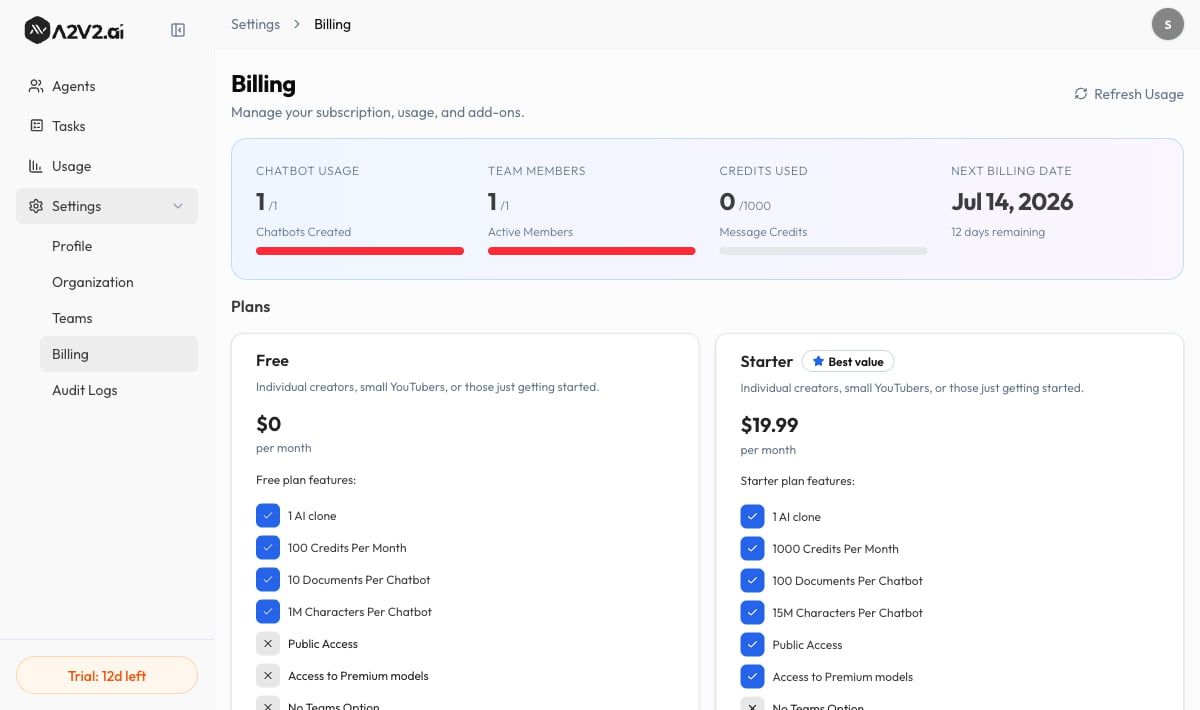
You can see your balance any time under **Billing** in your organization
settings, and track spending over time on the **Usage** and **Analytics** pages.
## Your two credit pools
Every organization has two separate pools of credits. They're spent in order —
plan credits first, then top-up credits — so your purchased credits are only
touched once the plan allowance runs low.
| Pool | Shown as | How you get it | Resets each period? |
| ------------------ | ------------------------------------------- | --------------------------------------------------------------------- | ------------------------------------------ |
| **Plan credits** | Message Credits | Included with your subscription every billing period | Yes — refilled at the start of each period |
| **Top-up credits** | Top-up Credits ("Remaining from recharges") | Bought via [auto-recharge](/billing/auto-recharge) or a manual top-up | No — they carry over |
Because top-up credits don't reset, anything you buy is never lost at the period
boundary. Plan credits, on the other hand, refill — they don't roll over, so
there's no benefit to "saving" them.
 ## What spends credits
Credits are consumed by the work an agent actually does:
| Activity | When it happens | Notes |
| ------------------------ | ------------------------------------------------------- | ----------------------------------------------------------------------------------------------------------- |
| **Message generation** | Every time an agent answers a visitor | Cost depends on the **model** powering the agent — premium models cost more per message than standard ones. |
| **Document processing** | When a source is added to a knowledge base and indexed | A one-time cost as the content is read and made searchable. |
| **Voice transcription** | When a visitor sends a voice message that's transcribed | Charged per recording. |
| **Agent tools / skills** | When an agent runs a tool to complete a task | Charged per tool run, on top of the message. |
The exact credit cost of each model is shown in the **Sandbox** model selector as
**"Credits cost:"** when you pick a model, so you can compare before committing an
agent to a premium model.
If a high-traffic agent is burning through credits faster than you'd like, check
which model it uses on [Model & settings](/building/model-settings). A lighter
model can cut your per-message cost substantially while still answering well from
a strong knowledge base.
Testing in the **Playground** is free — internal test messages there don't draw
from your credit balance. Costs apply to your live, embedded agents and the
sources you process.
## What happens at zero balance
Credits are checked at the moment an agent tries to act, not before:
* When the balance reaches **0**, an agent **stops generating new answers**.
Visitors see a notice that there aren't enough credits to respond.
* **Voice** messages show *"Insufficient credits to transcribe this recording."*
* Your existing agents, knowledge bases, contacts, and settings are **untouched** —
nothing is deleted. Only new AI work pauses.
Answering resumes the moment credits are available again, which happens when:
1. Your **plan credits refill** at the start of the next billing period, or
2. You **top up** — either manually or automatically via
[auto-recharge](/billing/auto-recharge).
For agents that customers rely on, leaving the balance to hit zero means
real visitors get turned away. Turn on [auto-recharge](/billing/auto-recharge)
so a busy spell can't take your agents offline.
## Troubleshooting
Your credit balance most likely reached zero. Open **Billing** to check, then
either wait for your plan period to reset or
[top up your credits](/billing/auto-recharge). Turning on auto-recharge
prevents this from happening again.
A premium model costs more per message than a standard one, and high traffic
multiplies that. Review the model on
[Model & settings](/building/model-settings) and compare costs in the Sandbox
model selector. Document processing and voice transcription also draw credits.
Use **Refresh Usage** on the Billing page to pull the latest figures. Top-up
credits appear under **Top-up Credits** ("Remaining from recharges"), separate
from your monthly plan credits.
## Related
What each plan includes and how much credit it gives you.
Top up automatically so agents never stop answering.
Subscribe and manage your payment method.
How credits fit with agents, knowledge, and RAG.
## What spends credits
Credits are consumed by the work an agent actually does:
| Activity | When it happens | Notes |
| ------------------------ | ------------------------------------------------------- | ----------------------------------------------------------------------------------------------------------- |
| **Message generation** | Every time an agent answers a visitor | Cost depends on the **model** powering the agent — premium models cost more per message than standard ones. |
| **Document processing** | When a source is added to a knowledge base and indexed | A one-time cost as the content is read and made searchable. |
| **Voice transcription** | When a visitor sends a voice message that's transcribed | Charged per recording. |
| **Agent tools / skills** | When an agent runs a tool to complete a task | Charged per tool run, on top of the message. |
The exact credit cost of each model is shown in the **Sandbox** model selector as
**"Credits cost:"** when you pick a model, so you can compare before committing an
agent to a premium model.
If a high-traffic agent is burning through credits faster than you'd like, check
which model it uses on [Model & settings](/building/model-settings). A lighter
model can cut your per-message cost substantially while still answering well from
a strong knowledge base.
Testing in the **Playground** is free — internal test messages there don't draw
from your credit balance. Costs apply to your live, embedded agents and the
sources you process.
## What happens at zero balance
Credits are checked at the moment an agent tries to act, not before:
* When the balance reaches **0**, an agent **stops generating new answers**.
Visitors see a notice that there aren't enough credits to respond.
* **Voice** messages show *"Insufficient credits to transcribe this recording."*
* Your existing agents, knowledge bases, contacts, and settings are **untouched** —
nothing is deleted. Only new AI work pauses.
Answering resumes the moment credits are available again, which happens when:
1. Your **plan credits refill** at the start of the next billing period, or
2. You **top up** — either manually or automatically via
[auto-recharge](/billing/auto-recharge).
For agents that customers rely on, leaving the balance to hit zero means
real visitors get turned away. Turn on [auto-recharge](/billing/auto-recharge)
so a busy spell can't take your agents offline.
## Troubleshooting
Your credit balance most likely reached zero. Open **Billing** to check, then
either wait for your plan period to reset or
[top up your credits](/billing/auto-recharge). Turning on auto-recharge
prevents this from happening again.
A premium model costs more per message than a standard one, and high traffic
multiplies that. Review the model on
[Model & settings](/building/model-settings) and compare costs in the Sandbox
model selector. Document processing and voice transcription also draw credits.
Use **Refresh Usage** on the Billing page to pull the latest figures. Top-up
credits appear under **Top-up Credits** ("Remaining from recharges"), separate
from your monthly plan credits.
## Related
What each plan includes and how much credit it gives you.
Top up automatically so agents never stop answering.
Subscribe and manage your payment method.
How credits fit with agents, knowledge, and RAG.