> ## Documentation Index
> Fetch the complete documentation index at: https://docs.a2v2.ai/llms.txt
> Use this file to discover all available pages before exploring further.
# Conversation History
> Review every past conversation your agent has had, see which sources grounded each answer, and correct answers that missed.
It's Monday morning and you want to know what your customers asked your agent all
last week — which questions came up most, where the answers were spot-on, and where
the agent fumbled. **History** is where you read those conversations back, see exactly
which knowledge sources each answer was built from, and fix the answers that weren't
quite right.
Open **Agent → History** from the agent sidebar. The page title is **History**, with
the subtitle "Review past conversations between your users and your agent."
## Prerequisites
* An agent (see [Create an agent](/building/create-agent)).
* At least one real conversation — History fills in once visitors start chatting with
your [embedded](/embed/install) or [shared](/embed/install) agent. You can also
generate conversations yourself from the [Sandbox](/testing/sandbox) or
[Playground](/testing/playground).
## How History is organized
History is grouped **by the person who chatted** (the visitor or client), then by each
**conversation** that person had. A signed-in visitor shows by name; an unidentified
visitor shows as **Anonymous User**.
In the agent sidebar, open **Agent → History**.
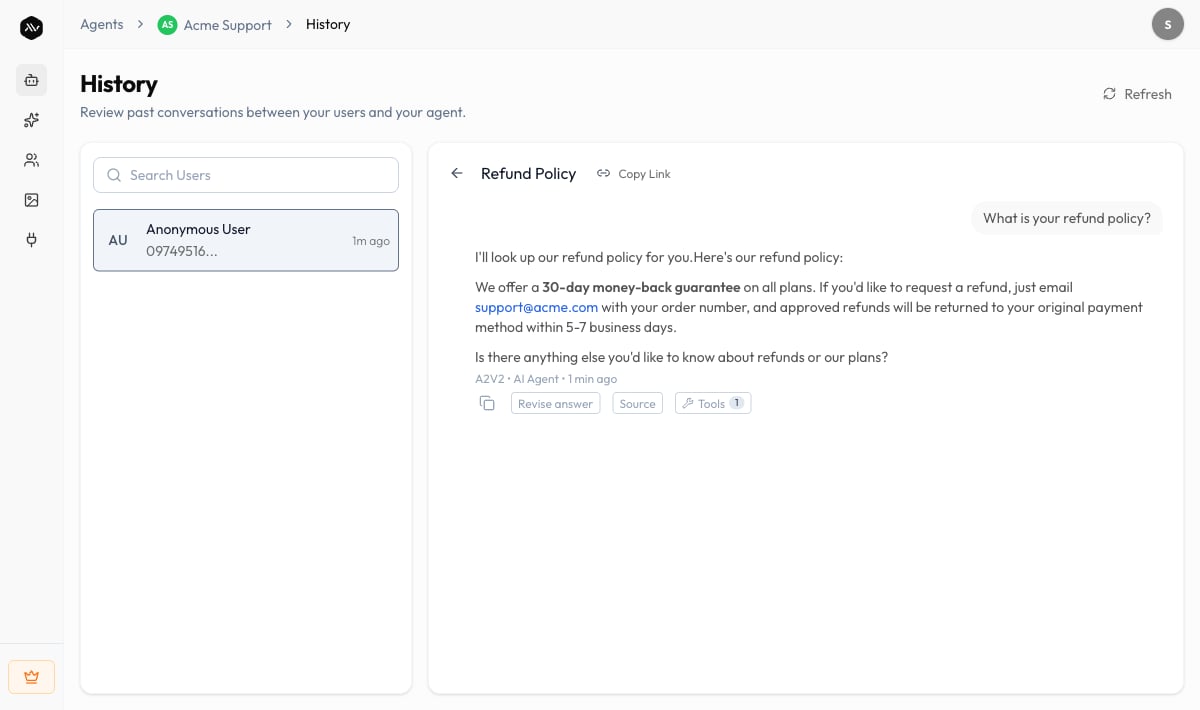 The left list shows everyone who has chatted with this agent. Use **Search Users**
to find someone by name. Before you select anyone, the panel reads "Select a user —
Choose a user from the list to view their conversations." If no one has chatted yet,
you'll see **No users yet**.
Selecting a user shows their list of conversations (titled "{'{'}Name{'}'}'s Chats").
Click any conversation to read it. A conversation without a set title shows as
**Untitled Conversation**.
The conversation detail pane shows the full back-and-forth — the visitor's questions
and your agent's answers, in order. Use **Refresh** to pull in new messages from
conversations still in progress.
## Source citations on answers
Every answer your agent gives is **grounded** in your knowledge base — it retrieves the
most relevant content from your sources and writes the answer from that, rather than
guessing. History lets you see exactly which sources backed each answer.
On an answer in the transcript, open **Source** to see the list of knowledge sources
the agent drew from for that specific reply. Each entry shows the source's **ID**,
**Name**, **Type**, whether it's **Archived**, and when it was **Created**. If an answer
wasn't built from any stored source, you'll see **No sources available**.
Source citations are your fastest way to audit answer quality. If an answer is wrong,
the citations tell you *why*: either the agent pulled from the wrong source, or the right
source isn't in your [knowledge base](/knowledge-base/overview) yet. See
[how grounding works](/concepts) for the bigger picture.
The left list shows everyone who has chatted with this agent. Use **Search Users**
to find someone by name. Before you select anyone, the panel reads "Select a user —
Choose a user from the list to view their conversations." If no one has chatted yet,
you'll see **No users yet**.
Selecting a user shows their list of conversations (titled "{'{'}Name{'}'}'s Chats").
Click any conversation to read it. A conversation without a set title shows as
**Untitled Conversation**.
The conversation detail pane shows the full back-and-forth — the visitor's questions
and your agent's answers, in order. Use **Refresh** to pull in new messages from
conversations still in progress.
## Source citations on answers
Every answer your agent gives is **grounded** in your knowledge base — it retrieves the
most relevant content from your sources and writes the answer from that, rather than
guessing. History lets you see exactly which sources backed each answer.
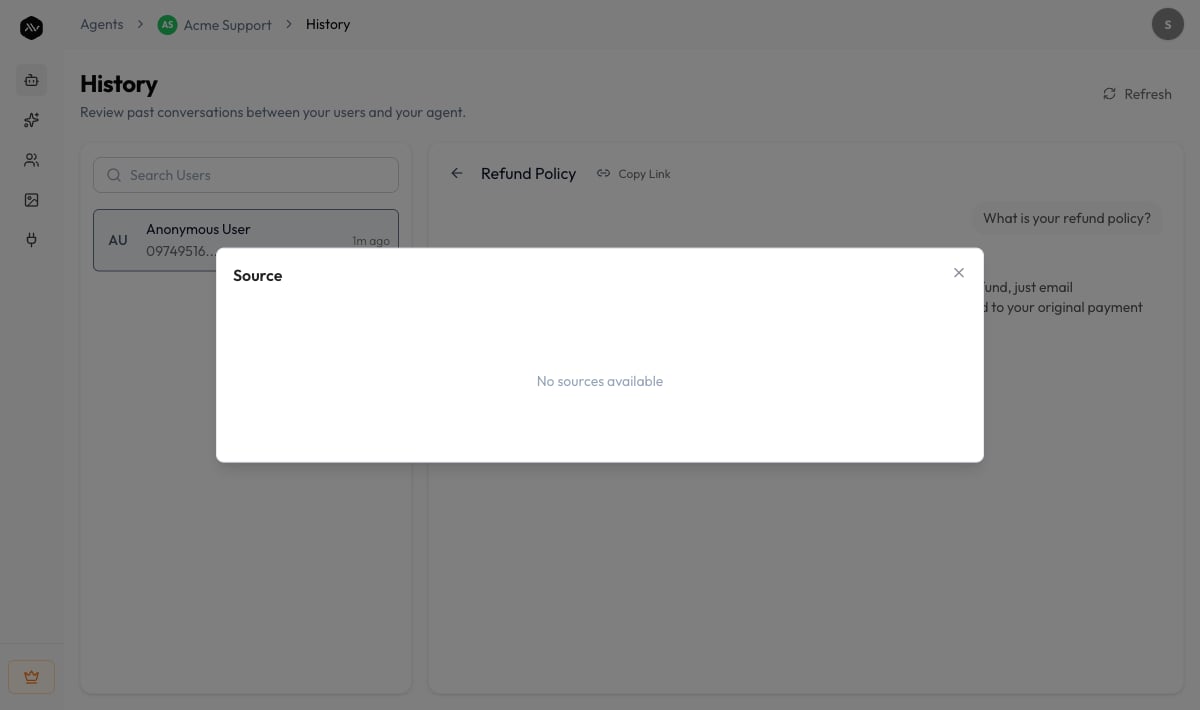
On an answer in the transcript, open **Source** to see the list of knowledge sources
the agent drew from for that specific reply. Each entry shows the source's **ID**,
**Name**, **Type**, whether it's **Archived**, and when it was **Created**. If an answer
wasn't built from any stored source, you'll see **No sources available**.
Source citations are your fastest way to audit answer quality. If an answer is wrong,
the citations tell you *why*: either the agent pulled from the wrong source, or the right
source isn't in your [knowledge base](/knowledge-base/overview) yet. See
[how grounding works](/concepts) for the bigger picture.
 When your agent uses a [tool or skill](/building/skills) to answer, the transcript also
shows a **Tools used** block under the message, including how many credits that step
cost.
## Correct an answer that missed
When you find an answer that wasn't right, you don't have to leave History to fix it.
Open **Revise Answer** on the agent's message to record what the answer *should* have
been.
On the agent message you want to correct, open **Revise Answer**. The dialog shows
the original **User message** and the **Bot Response** for context.
In **Expected Response**, type the answer the agent should have given (at least 10
characters). Save to record it — you'll see "Answer revised successfully."
Pair this with your knowledge base: if the agent missed because a source was missing or
thin, add or improve that source in
[Knowledge Base](/knowledge-base/overview). Revising the answer captures the correct
response; improving the source helps the agent get it right next time on its own.
## Share a conversation
To hand a conversation to a teammate, open it and use **Copy link to this conversation**.
The link is copied to your clipboard ("Link copied to clipboard") so you can paste it
into a chat or ticket. Teammates need access to the agent to open it.
## Delete a conversation or client
You can remove individual conversations, or remove a client and everything they sent.
* **Delete a conversation** — use **Delete conversation** on the conversation you want
to remove.
* **Delete a client** — use **Delete client** on a person in the users list. This opens
**Delete Client**: "This action will permanently delete this client and all their
conversation history."
Deleting is permanent. Deleting a client removes **all** of that person's conversation
history, not just one chat. There's no undo.
## Options reference
| Action | Where | What it does |
| ---------------------------------- | ------------------------- | ---------------------------------------------------------------------------------------- |
| **Search Users** | Left users list | Filter the list of people who have chatted |
| **Refresh** | Users / conversation list | Reload to pull in new conversations and messages |
| **Source** | On an agent message | Show the knowledge sources that grounded that answer (ID, Name, Type, Archived, Created) |
| **Tools used** | Under an agent message | Shows any tools/skills the agent ran for that answer, with credit cost |
| **Revise Answer** | On an agent message | Record the expected response for an answer that missed |
| **Copy link to this conversation** | Conversation detail | Copy a shareable link to the open conversation |
| **Delete conversation** | On a conversation | Permanently delete a single conversation |
| **Delete client** | On a user | Permanently delete a person and all their conversation history |
## Tips
* Skim **Source** on a sample of answers each week — it's the quickest way to spot
knowledge gaps before customers complain.
* Use the questions you see here as a backlog: turn the most common ones into
[suggested questions](/customize/messages) or new
[Q\&A sources](/knowledge-base/overview) so the next visitor gets an instant, accurate
answer.
* Reading real transcripts is the best input for refining your
[Instructions](/building/instructions) — you'll notice tone and formatting issues a
test chat never surfaces.
## Troubleshooting
History only fills in once people actually chat with your agent. Confirm your agent
is live and reachable (check [Visibility](/embed/visibility) and your
[embed](/embed/install)), then send yourself a test message from the
[Sandbox](/testing/sandbox) and use **Refresh**.
The conversation or client may have been deleted, or the link you followed is no
longer valid. Use **Back to chat history** and reopen it from the current list.
That answer wasn't built from a stored knowledge source — for example a greeting, a
general reply, or a question your knowledge base doesn't cover yet. If it should have
been grounded, add the missing material in
[Knowledge Base](/knowledge-base/overview).
That's expected for visitors who chatted without signing in. Identified visitors —
such as those who log in to a [restricted agent](/embed/visibility) — show by name.
## Related
Add and improve the sources your answers are grounded in.
Refine your agent's behavior based on what you read in transcripts.
Reproduce and test fixes before they reach visitors.
Turn common questions into suggested questions.
When your agent uses a [tool or skill](/building/skills) to answer, the transcript also
shows a **Tools used** block under the message, including how many credits that step
cost.
## Correct an answer that missed
When you find an answer that wasn't right, you don't have to leave History to fix it.
Open **Revise Answer** on the agent's message to record what the answer *should* have
been.
On the agent message you want to correct, open **Revise Answer**. The dialog shows
the original **User message** and the **Bot Response** for context.
In **Expected Response**, type the answer the agent should have given (at least 10
characters). Save to record it — you'll see "Answer revised successfully."
Pair this with your knowledge base: if the agent missed because a source was missing or
thin, add or improve that source in
[Knowledge Base](/knowledge-base/overview). Revising the answer captures the correct
response; improving the source helps the agent get it right next time on its own.
## Share a conversation
To hand a conversation to a teammate, open it and use **Copy link to this conversation**.
The link is copied to your clipboard ("Link copied to clipboard") so you can paste it
into a chat or ticket. Teammates need access to the agent to open it.
## Delete a conversation or client
You can remove individual conversations, or remove a client and everything they sent.
* **Delete a conversation** — use **Delete conversation** on the conversation you want
to remove.
* **Delete a client** — use **Delete client** on a person in the users list. This opens
**Delete Client**: "This action will permanently delete this client and all their
conversation history."
Deleting is permanent. Deleting a client removes **all** of that person's conversation
history, not just one chat. There's no undo.
## Options reference
| Action | Where | What it does |
| ---------------------------------- | ------------------------- | ---------------------------------------------------------------------------------------- |
| **Search Users** | Left users list | Filter the list of people who have chatted |
| **Refresh** | Users / conversation list | Reload to pull in new conversations and messages |
| **Source** | On an agent message | Show the knowledge sources that grounded that answer (ID, Name, Type, Archived, Created) |
| **Tools used** | Under an agent message | Shows any tools/skills the agent ran for that answer, with credit cost |
| **Revise Answer** | On an agent message | Record the expected response for an answer that missed |
| **Copy link to this conversation** | Conversation detail | Copy a shareable link to the open conversation |
| **Delete conversation** | On a conversation | Permanently delete a single conversation |
| **Delete client** | On a user | Permanently delete a person and all their conversation history |
## Tips
* Skim **Source** on a sample of answers each week — it's the quickest way to spot
knowledge gaps before customers complain.
* Use the questions you see here as a backlog: turn the most common ones into
[suggested questions](/customize/messages) or new
[Q\&A sources](/knowledge-base/overview) so the next visitor gets an instant, accurate
answer.
* Reading real transcripts is the best input for refining your
[Instructions](/building/instructions) — you'll notice tone and formatting issues a
test chat never surfaces.
## Troubleshooting
History only fills in once people actually chat with your agent. Confirm your agent
is live and reachable (check [Visibility](/embed/visibility) and your
[embed](/embed/install)), then send yourself a test message from the
[Sandbox](/testing/sandbox) and use **Refresh**.
The conversation or client may have been deleted, or the link you followed is no
longer valid. Use **Back to chat history** and reopen it from the current list.
That answer wasn't built from a stored knowledge source — for example a greeting, a
general reply, or a question your knowledge base doesn't cover yet. If it should have
been grounded, add the missing material in
[Knowledge Base](/knowledge-base/overview).
That's expected for visitors who chatted without signing in. Identified visitors —
such as those who log in to a [restricted agent](/embed/visibility) — show by name.
## Related
Add and improve the sources your answers are grounded in.
Refine your agent's behavior based on what you read in transcripts.
Reproduce and test fixes before they reach visitors.
Turn common questions into suggested questions.