

Available on Medical Agents
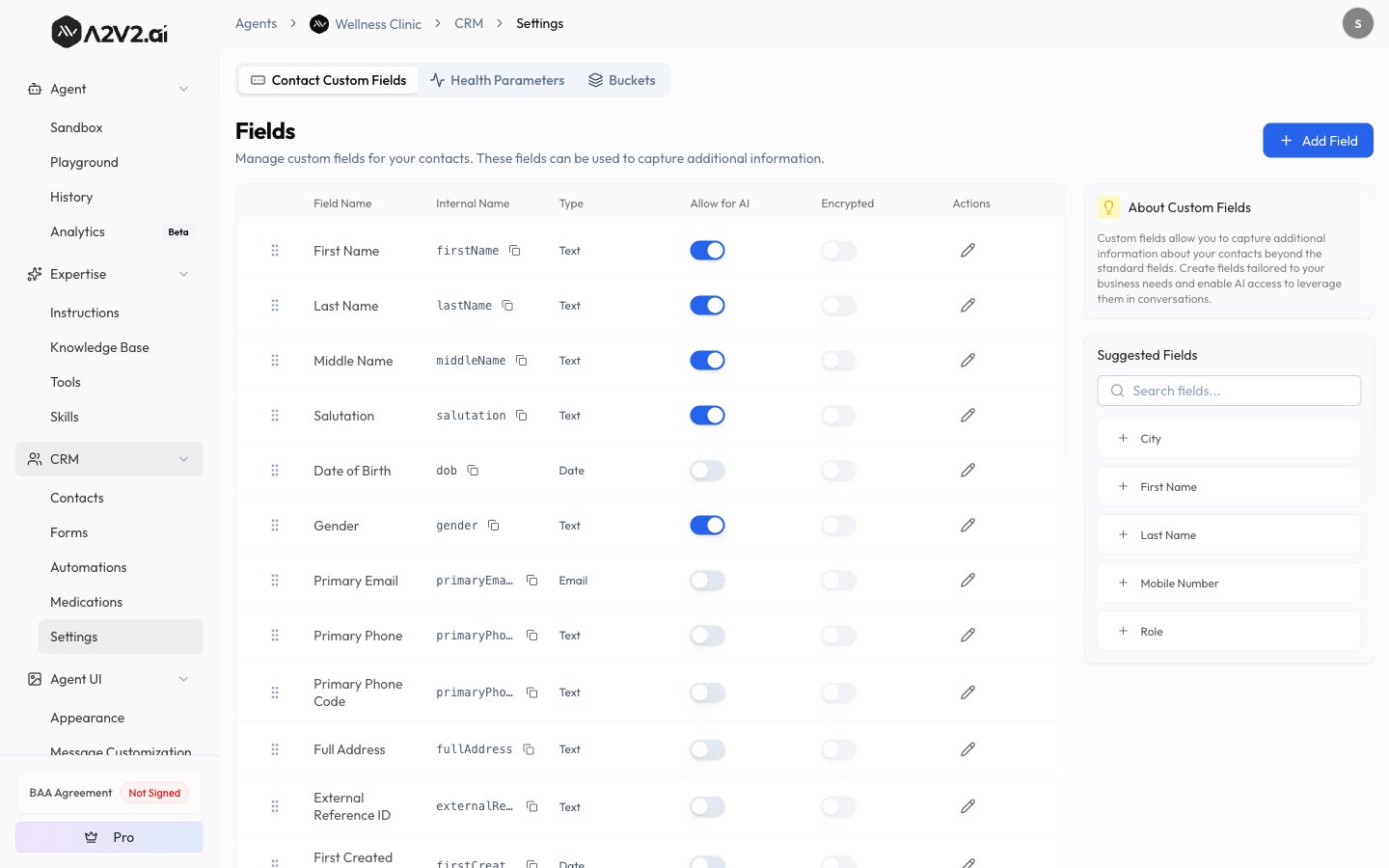
Encryption is a Medical Agent capability. The encryption controls — the Encrypted column and Encrypt this field switch on the Fields screen, and the Encrypt form data setting in the Form Builder — appear only on Medical Agents. On other agent types you won’t see these options.An agent’s type is set when you create it. If you need encryption on an agent that isn’t
a Medical Agent, create a Medical Agent for that work rather than expecting the option
to appear on an existing general agent.
What encryption does — and doesn’t do
Encryption protects the stored copy of your data. It is not a way to hide values from your own team or the agent.- It encrypts values at rest. Encrypted values are stored as ciphertext in the database instead of readable text, so the stored data isn’t legible on its own.
- Each agent has its own encryption key. One agent’s encrypted data can’t be read with another agent’s key.
- It is not access control. When an authorized team member opens a contact or a submission, the values are decrypted automatically and shown normally. Encryption guards the data where it’s stored — it doesn’t change who can view it.
- It is separate from “Allow for AI.” Turning on encryption for a field does not hide that field from the agent. Whether the agent can read and capture a field is still governed by its Allow for AI setting, independently of encryption. See custom fields.
If your goal is to keep a value away from people or the agent — rather than to protect
it at rest — use roles to limit who can view a contact,
and leave Allow for AI off for fields the agent shouldn’t use. Encryption and access
control solve different problems.
Two things you can encrypt
A custom field
Turn on Encrypt this field for an individual custom field. Its values are stored
encrypted on every contact.
A whole form
Turn on Encrypt form data for a form. Every submission’s data for that form is
stored encrypted.
It’s one-way
Encryption is deliberate and permanent — plan for it before you turn it on.What changes once it’s on
Working with regulated health data
Encryption is one piece of handling sensitive data, not a compliance certification on its own. If you’re building a healthcare workflow, it usually pairs with a HIPAA-eligible model and the right agreements in place for your organization.Troubleshooting
I don't see any encryption option
I don't see any encryption option
Encryption controls appear on Medical Agents only. On other agent types the
Encrypted column, the Encrypt this field switch, and Encrypt form data
won’t show. Create a Medical Agent for work that needs encryption.
The Encrypt switch is disabled on a field
The Encrypt switch is disabled on a field
Only custom fields can be encrypted. The standard Name, Email, and Phone fields
show the switch disabled with “Only custom fields can be encrypted.” Add a custom
field for the value you want to protect.
I can't turn encryption off
I can't turn encryption off
That’s expected — encryption is one-way. Once enabled for a field or form it can’t be
disabled. If you no longer need an encrypted field, delete it and create a new,
unencrypted one.
My team can still see the encrypted values
My team can still see the encrypted values
That’s expected. Encryption protects data at rest; it isn’t access control.
Authorized team members see decrypted values when they open a contact. To limit who
can view a contact, use roles.
Related
Custom fields
Add and encrypt the custom fields your agent collects.
Forms
Build forms and encrypt their submission data.
Data privacy & isolation
How A2V2.ai keeps each organization’s and agent’s data separate and private.
Members & roles
Control who on your team can view and manage contacts.