

The Forms screens — the form list, Form Builder, and Form Preview — are
desktop only. On a small screen you’ll see a “Desktop Only” message asking you to
switch to a larger display.
Prerequisites
- An agent (see Create an agent).
- The fields you want to collect in mind. Forms can reuse the same field types as your custom fields.
How forms work
A form has two parts:- A template — the form you design once (its name, fields, and settings).
- Submissions — each time someone fills the form in, a submission is recorded and attached to a contact’s Form tab.
Build a form
1
Create a form
On the Forms page, select Add Form. The Create Form builder opens with
the subtitle “Build a custom form to collect information from your contacts.”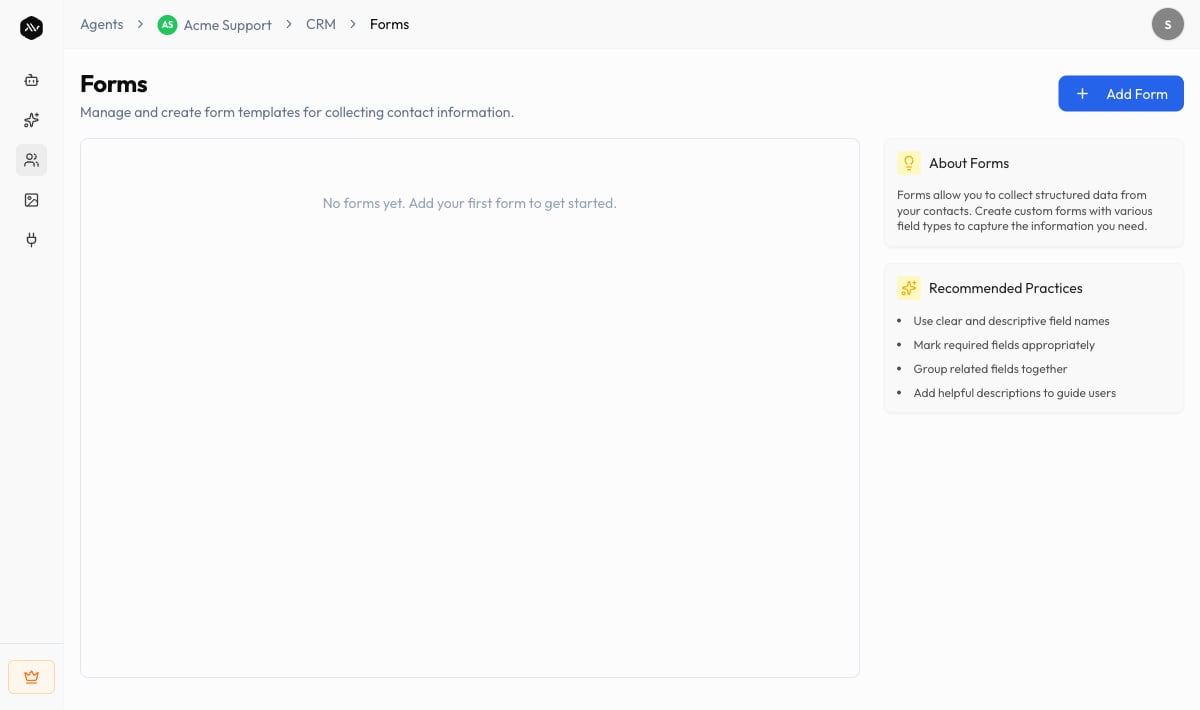
2
Name it
In the settings panel, give the form a Form Name and an optional Description.
3
Add fields by dragging
From the Form Fields palette (“Drag and drop the field type you want to add to
your form”), drag a type onto the canvas — or click Add Field. Available types:
Text Field, Mail, Number, Check Box, Radio Button, Dropdown,
Calendar, and Description. An empty form reads “No fields added yet.”
4
Preview and save
Use Preview Form to see exactly how it’ll look to the person filling it in. A
form needs a name and at least one field. Save to create the template.
Form settings
The Encrypt form data setting appears on Medical Agents only. Like encrypted
custom fields, it protects submission data at rest — it doesn’t hide values from your
team, who see them decrypted when reviewing a submission. See
Data encryption for the full picture.
Share a form
Select Share on a form to get a Share Link — “Anyone with this link can fill out the form.” Send it by email, drop it on a landing page, or link it from your site. Submissions come back into the CRM and attach to a contact.Submissions
Each completed form is a submission. You’ll find a contact’s submissions on the Form tab of their contact record. A submission is either a Draft (started, not finished) or Submitted. To record a submission yourself, open a contact’s Form tab and select Create Submission, then choose a template from Select Form Template and fill it in.AI File Extraction
Instead of retyping a document into a form, you can let A2V2.ai read it for you.1
Start an extraction
On a form submission, select AI File Extraction and upload a document (PDF, DOC,
or DOCX, up to 20MB) — or choose one from the contact’s existing files.
2
Review the result
A2V2.ai processes the document and pre-fills the form, reporting how many fields it
extracted and with what confidence (“Form data extracted! Please review and submit”).
It only fills empty fields — anything you’ve already typed is left untouched.
Always review the values before submitting.
AI File Extraction on a form uses credits (it’s an AI operation), and it only fills
fields that are empty and enabled for AI. Nothing is saved until you review and submit.
Use cases
- Lead intake — a “Get a quote” form shared as a link, feeding straight into your contacts.
- Event or demo signup — collect name, company, and a preferred time.
- Document-driven onboarding — upload a client’s paperwork and let AI File Extraction fill the form.
Troubleshooting
The Forms page says Desktop Only
The Forms page says Desktop Only
Building, previewing, and managing forms is available on desktop only. Open the
agent on a larger screen.
I can't save my form
I can't save my form
A form needs a Form Name and at least one field before it can be saved. Add a
field from the palette, then save.
AI File Extraction won't accept my file
AI File Extraction won't accept my file
Extraction supports PDF and DOC/DOCX files up to 20MB. Convert or compress other
formats first.
A submission isn't showing on the contact
A submission isn't showing on the contact
Submissions attach to the contact they were created for. Open that contact and check
the Form tab; drafts appear there too, marked Draft.
Related
Custom fields
The field types forms are built from.
Contacts
Where submissions land — on the contact’s Form tab.
Automations
Auto-assign and stage the contacts your forms create.
AI File Extraction
Pre-fill a form from an uploaded document instead of retyping it.
Data encryption
What encrypting form data protects — and what it doesn’t.
CRM overview
How forms fit into the wider CRM.